




Small expansion, giant leap in quality for Haas lathes
It’s always easy to complain—that Haas machines lack rigidity, the castings are too light, the linear guides aren't enough, the sub-spindles are underpowered, or the footprints just aren't right. But since every critique holds a grain of truth, Haas identified exactly what needed to be refined. By listening to customer feedback, they closed the year by introducing two game-changing innovations that redefine their lathe lineup.
From complaints to concrete solutions – what Haas decided to improve
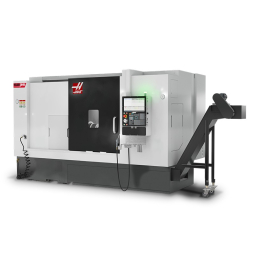
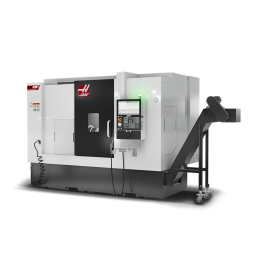
Slant-bed lathes with box ways are simply superior – there is little room for debate here. A slant bed, designed with an inclined guideway system relative to the horizontal axis, provides significantly higher rigidity for the entire machine-tool-workpiece system. This is due to a more favorable distribution of cutting forces within the bed's cross-section (the casting gets "thicker where it hurts"). Additionally, it lowers the center of gravity for moving components, enhances axis dynamics and positioning accuracy, and naturally facilitates chip and coolant evacuation from the cutting zone—without requiring the operator to grab a broom. As a bonus, this geometry allows for a more compact arrangement of the turret and auxiliary axes, making the lathe more "CNC-friendly" and less temperamental during heavy-duty machining.
Box ways compared to linear guides represent the classic "tank vs. suitcase rollers" dilemma: box ways are slower (though they still offer 20m/min in the Z-axis), but they are incredibly stable and resistant to overloads, vibrations, and the brutal reality of heavy-duty machining. Thanks to the large contact surface area, they provide excellent vibration damping and high static rigidity, which translates into superior surface finishes and greater repeatability—the machine doesn't resonate at the slightest whim of the tool. While linear guides win on dynamics and ease of movement, box ways are unfazed by chips, impacts, or high cutting forces, and they wear in a more predictable and "refined" manner. For the non-technical: it’s the difference between ice skating (fast and agile, but easy to slip) and sliding a heavy cabinet on felt pads—slower, but stable and surprise-free. Add to this an optional gearbox with a 40hp drive (roughly 30kW) and 1900Nm of maximum torque (available from approximately 500 RPM), and you have a serious, heavy-duty lathe that can handle shafts up to 1260mm long and 350mm in diameter on its 305mm chuck.
Expansion of the DS Series – No More Compromises Between Size and the Sub-Spindle

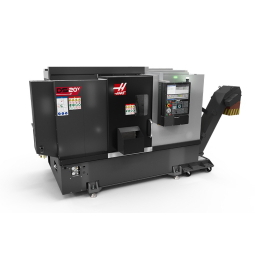
For years, Haas offered the DS-30Y—an excellent model featuring a robust 11.2 kW sub-spindle, dual C-axis capability, and a wealth of options. Meanwhile, the sales leader in Poland was the ST-20Y: a smaller (yet still highly capable), faster, and more affordable lathe that boasted numerous advantages, but came with a significantly weaker optional sub-spindle—barely 8 kW at high RPMs and a maximum chuck size of only 135 mm. So, what was the choice, ladies and gentlemen? Either a dual-spindle machine that was too large, too heavy, and too expensive, or a sleek, faster, more economical lathe compromised by a weak sub-spindle? No more such dilemmas. Entering the scene like a knight on a white horse: the DS-20Y (and the DS-25Y). It is quite literally the best of both worlds—the powerhouse "DS" sub-spindle transplanted into the "20" frame is the ultimate recipe for success. The first units are selling like hotcakes, but don't worry—we’ve saved one for you in our Warsaw showroom and will be giving you a closer look very soon.


SB Series – slant bed and box ways, or Haas in heavy-duty work boots

Haas has done something no one expected, yet everyone secretly wanted: they listened to the users. Yes, the same ones who for years said, "nice, but it could be stiffer," "fast, but a bit too light," and "why is this sub-spindle so… symbolic." The result? Two innovations that aren't just a revolution on paper, but make a huge difference in a real workshop. First—the SB series, or Haas putting on its heavy-duty work boots. Slant bed, box ways, mass where mass matters, and torque that doesn't ask the tool for permission. This is no longer a lathe that just "copes with heavy machining," but one that feels right at home in it. Slower? A bit. Stabler? Definitely. And the surface finish after machining speaks for itself. Second—the DS-20Y and DS-25Y, the answer to the eternal dilemma of choice: either the compact ST-20Y with a sub-spindle for "delicate matters," or the large DS-30Y that does everything but takes up half the floor and budget. The new models are exactly that missing piece of the puzzle—a smaller machine, but with a proper sub-spindle, no compromises, and no explaining to the customer that "this can't be picked up." In short: it’s not a massive change in the catalog, but a very big change in production reality. Haas has stopped proving that "it's enough" and started showing that it can be solid.



FAQ
What is the practical difference between the ST-20Y and the DS-30Y?
ST-20Y is a compact, fast lathe with a Y-axis and live tooling, ideal for the serial production of small to medium-sized parts.
The DS-30Y is in a heavier class: two spindles, full machining from two sides in a single setup, and greater sub-spindle capabilities. If the ST-20Y is a sprinter, the DS-30Y is a marathon runner with a backpack full of tools.
What is the actual purpose of the Y-axis in Haas lathes?
The Y-axis allows for off-center milling, drilling away from the part's centerline, and more complex operations without removing the part from the machine. Fewer operations, fewer errors, and less stress for the operator – more finished parts.
What is the difference between the SB series and classic Haas lathes with linear guides?
The SB features box ways and a slant bed, which means:
higher rigidity,
better vibration damping,
greater resistance to heavy-duty machining,
more stable surface finish quality.
It is a machine built for "dirty work," not for breaking rapid travel speed records.
What are the main advantages of the DS?
- two fully functional spindles,
- dual C-axis,
- the ability to complete full part machining in a single cycle,
- excellent sub-spindle parameters,
- high flexibility for medium and high-volume production.
It is a machine that "gets the job done," even when the part has two ends and both need to be perfect.
For whom does the ST-20Y still make sense?
For workshops that:
- need a fast and universal lathe,
- machine smaller parts,
- value shorter cycle times and a lower entry cost,
- do not require a high-power sub-spindle.
The ST-20Y remains one of the most versatile models in the Haas lineup.
For whom does the DS-30Y still make sense?
For companies that:
- need a larger chuck than the ST-20, as the DS-35Y option is available
- need greater turning length
- will utilize the full 3" spindle bore
In other words, for companies for which the new DS-20Y might be too small
